

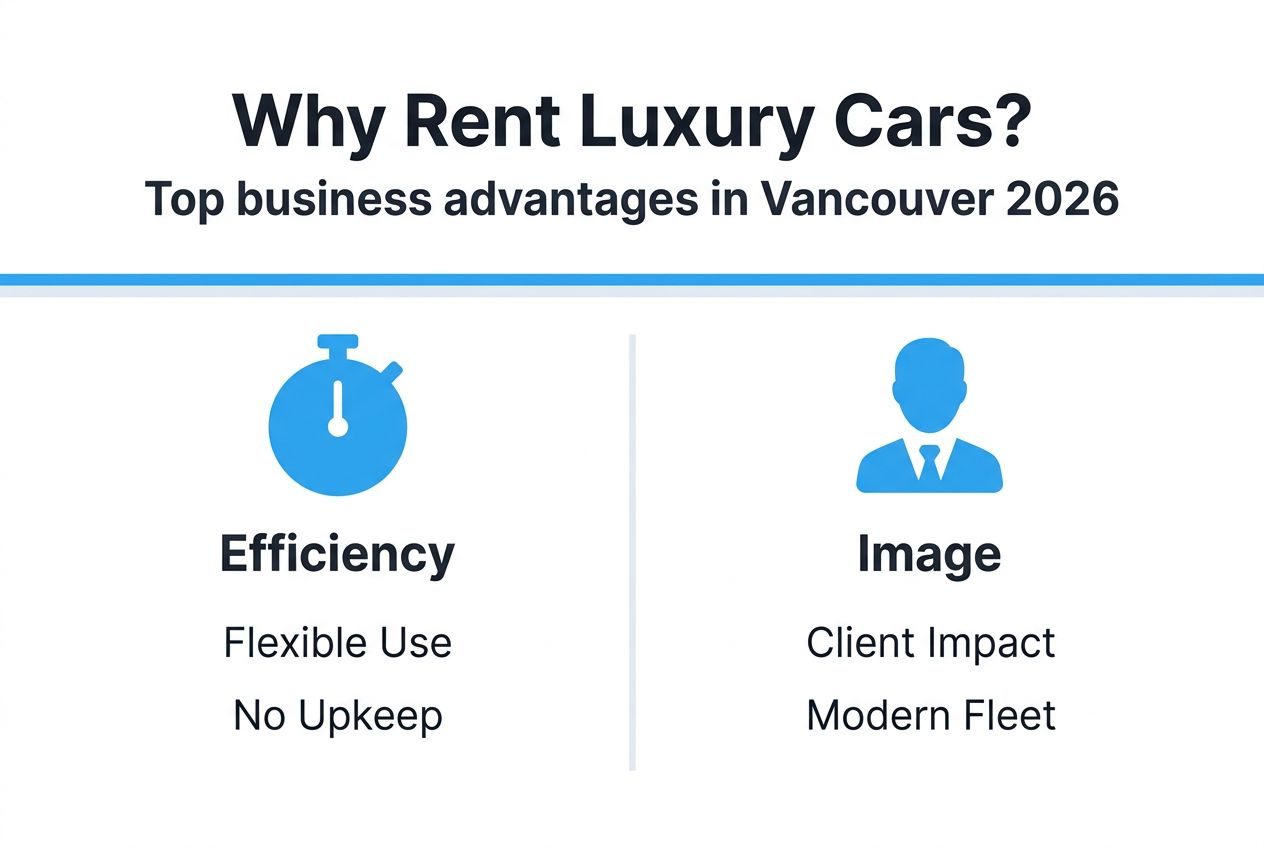
Most executives believe owning luxury vehicles is the smartest way to project success and control costs. That assumption overlooks the flexibility, tax advantages, and strategic benefits renting provides for corporate travel and events. In 2026, renting luxury cars for business in Vancouver delivers tangible financial and operational advantages that ownership simply cannot match, especially when paired with Vancouver’s evolving corporate landscape.
Table of Contents
-
Comfort, Safety And Variety: Enhancing Your Business Travel Experience
-
Maximising Financial Benefits: Tax, Cost Predictability, And Simplified Accounting
-
Strategic Image And Client Impression: Boosting Your Business Presence With Luxury Rentals
-
Comparing Ownership, Leasing, And Renting: Which Option Fits Your Business Needs Best?
Key takeaways
| Point | Details |
|---|---|
| Comfort and variety | Luxury rentals offer spacious interiors, advanced safety features, and diverse models tailored to specific business needs. |
| Financial advantages | Rental expenses are typically fully deductible, simplifying accounting and avoiding depreciation complexity. |
| Client impression | Premium vehicles boost client satisfaction by 30% and enhance brand perception during meetings and events. |
| Flexibility | Renting eliminates long term commitments, allowing businesses to match vehicles to event requirements without ownership burdens. |
Comfort, safety and variety: enhancing your business travel experience
Luxury vehicles transform business travel from a logistical necessity into a competitive advantage. Luxury SUVs reduce travel stress by 15% through spacious cabins, adaptive suspension systems, and advanced driver assistance technologies that make long trips effortless. When you arrive at a client meeting refreshed rather than fatigued, you perform better.
Rental fleets in Vancouver now include everything from athletic sports cars to presidential SUVs, letting you match vehicles to specific occasions. Need to transport three executives and presentation materials to a waterfront conference? A Cadillac Escalade ESV provides ample room and commanding presence. Hosting international clients who expect understated elegance? A Rolls Royce Cullinan delivers that message without words.
The variety advantage extends beyond aesthetics. Different business scenarios demand different vehicle characteristics:
-
Airport transfers benefit from smooth, quiet cabins that facilitate phone calls and last minute preparation
-
Site visits require cargo space for equipment and samples
-
Client entertainment calls for vehicles that spark conversation and demonstrate success
-
Multi day conferences need comfortable seating for extended periods
Vancouver’s corporate environment increasingly values vehicles as mobile offices and relationship building tools. Luxury SUV rentals equipped with connectivity features let executives maintain productivity between meetings while projecting the professional image clients expect from premium service providers.
Maximising financial benefits: tax, cost predictability, and simplified accounting
The financial case for renting luxury vehicles centers on three pillars: tax treatment, predictable expenses, and administrative simplicity. Understanding these advantages requires examining how the Canada Revenue Agency treats different vehicle arrangements.
CRA limits capital cost allowance on passenger vehicles to $36,000 as of 2026, regardless of actual purchase price. Buy a $150,000 luxury sedan and you can only depreciate the first $36,000. The remaining $114,000 receives no tax benefit whatsoever. Rental expenses are fully deductible for legitimate business use, subject to reasonable limits.
This creates a substantial advantage for businesses using luxury vehicles occasionally rather than daily. Consider the comparison:
| Expense Type | Ownership | Leasing | Renting |
|---|---|---|---|
| Upfront cost | $150,000 | $0 | $0 |
| Monthly cost | Depreciation only | $2,500 fixed | Variable by use |
| Tax treatment | CCA limit $36,000 | Fully deductible | Fully deductible |
| Administrative burden | Track CCA, residual value | Monthly entries | Invoice by invoice |
| Flexibility | Locked in | 2-4 year term | No commitment |
Leasing fixes costs and simplifies budgeting compared to ownership, but still requires multi year commitments. Renting provides maximum flexibility, letting you scale vehicle use up or down based on actual business needs without carrying unutilised assets.
The accounting complexity difference is equally significant. Owned vehicles require tracking capital cost allowance schedules, calculating business use percentages, maintaining detailed mileage logs, and estimating residual values. Each year adds another layer to your depreciation schedule. Lease payments are fixed and predictable, making them easier to process, but you still manage a long term liability.
Rental expenses appear as single line items on your books. Pay the invoice, record the business purpose, and move on. This simplicity becomes valuable when managing multiple vehicle uses across quarters.
Pro Tip: Maintain a digital log capturing date, destination, business purpose, and mileage for every rental. CRA audits focus heavily on substantiating business use, and contemporaneous records provide the strongest defence for deductions.
The depreciation risk deserves special attention. Luxury vehicles lose value rapidly, especially in the first three years. Buy a premium sedan today and it might lose 40% of its value in 36 months. That loss hits your balance sheet directly. Renting transfers that risk entirely to the rental company, protecting your capital for higher return investments.
Strategic image and client impression: boosting your business presence with luxury rentals
Vehicles communicate before you say a word. Airport arrivals set the tone for entire business relationships, and luxury vehicles increase satisfaction by 30% during client interactions. That improvement translates directly to better meeting outcomes and stronger partnerships.

The psychology is straightforward. Clients form judgements about your success, attention to detail, and commitment to quality based on environmental cues. Arriving in a meticulously maintained luxury vehicle signals you value excellence in all aspects of business. It demonstrates you understand their expectations and invested effort in creating a positive experience.
Matching vehicles to specific occasions amplifies this effect. Corporate event rentals let you select vehicles that complement event formality and client preferences. Hosting venture capital partners at an exclusive dinner? A sophisticated sedan projects understated confidence. Entertaining clients at a sporting event? A high performance SUV adds excitement and energy.
The flexibility to choose appropriate vehicles for different contexts provides advantages ownership cannot match. You avoid being locked into a single vehicle that may suit some occasions poorly. Instead, you optimise every interaction.
Consider these practical applications:
-
Board meetings: Executive sedans demonstrate gravitas and respect for senior leadership
-
Client pitches: Modern, technology forward vehicles suggest innovation and forward thinking
-
Entertainment outings: Performance vehicles create memorable experiences that strengthen relationships
-
Multi client days: Spacious SUVs accommodate varying group sizes comfortably
Pro Tip: Brief your driver or familiarise yourself with vehicle features before client pickups. Being able to explain or demonstrate luxury amenities shows thoughtfulness and enhances the premium experience.
The brand alignment consideration matters particularly for service businesses. If you counsel clients on premium positioning and quality, your transportation choices should reflect those values. Inconsistency between your messaging and your presentation undermines credibility. Luxury rentals let you maintain alignment without the capital commitment of ownership.
Comparing ownership, leasing, and renting: which option fits your business needs best?
Choosing between ownership, leasing, and renting requires analysing your specific usage patterns, financial priorities, and operational requirements. No single approach suits every business, but understanding the trade-offs clarifies which option aligns with your goals in 2026.
Ownership involves upfront capital, ongoing maintenance responsibilities, depreciation risk, and complex accounting. Leasing fixes monthly costs within CRA limits and simplifies budgeting. Renting provides maximum flexibility without long term commitments. The right choice depends on how frequently you need luxury vehicles and what financial structure serves your business model.
| Factor | Ownership | Leasing | Renting |
|---|---|---|---|
| Capital required | High ($100,000+) | None | None |
| Monthly cost | Variable | Fixed | Variable by use |
| Mileage restrictions | None | Yes (penalties) | None |
| Flexibility | Low | Medium | High |
| Tax complexity | High (CCA tracking) | Medium | Low |
| Maintenance responsibility | Full | Partial | None |
| Depreciation risk | Full | None | None |
| Vehicle variety | Limited | Limited | Unlimited |
Follow this decision framework to identify your optimal approach:
-
Calculate annual luxury vehicle usage days. If under 100 days yearly, renting typically costs less than ownership or leasing.
-
Assess mileage requirements. High annual mileage (over 30,000 kilometres) favours ownership, as lease penalties become expensive.
-
Evaluate capital availability. If $100,000+ tied up in a depreciating asset impacts growth investments, renting preserves capital.
-
Consider variety needs. If different events require different vehicle types, renting provides options ownership cannot.
-
Review administrative capacity. Small businesses often lack resources for complex vehicle accounting, making rentals attractive.
-
Analyse tax position. Profitable businesses benefit most from rental deductions, whilst loss positions reduce the tax advantage.
The total cost of ownership extends beyond purchase price. Factor in insurance premiums (often $3,000-$5,000 annually for luxury vehicles), maintenance contracts, tyre replacements, unexpected repairs, and eventual resale complexity. Ownership makes sense primarily when daily use justifies these ongoing commitments.
Leasing suits businesses needing consistent luxury vehicle access without capital outlay. Fixed monthly payments simplify budgeting, though mileage restrictions can create penalties for high use scenarios. The best vehicles to rent for business professionals offer insights into matching vehicle types to corporate needs.
Renting excels for businesses with variable or event driven needs. You pay only for actual use, avoid all maintenance responsibilities, and adapt vehicle choices to specific occasions. The administrative simplicity and capital preservation benefits make renting increasingly popular amongst Vancouver’s corporate community.
Explore luxury car rental options with Vancouver Velocity
Navigating Vancouver’s luxury vehicle rental market requires a partner who understands corporate needs and delivers consistent excellence. Vancouver Velocity specialises in providing premium transportation solutions tailored for business executives and high net worth professionals.
Our luxury car rental fleet includes exotic vehicles and executive SUVs suited for every business scenario, from intimate client meetings to large corporate events. Whether you need a commanding presence for board presentations or sophisticated transport for international visitors, our team ensures seamless experiences that enhance your professional image. Luxury SUV rentals combine space, safety, and style, whilst our exotic options create memorable impressions that strengthen client relationships.
Frequently asked questions
Are luxury car rental expenses fully deductible for my business?
Rental expenses are generally fully deductible for legitimate business use, unlike owned vehicles which face CRA’s $36,000 capital cost ceiling regardless of purchase price. The CRA allows deductions for the business portion of vehicle expenses including rental fees, fuel, and related costs. Maintain detailed logs documenting each rental’s business purpose, dates, destinations, and mileage to substantiate deductions during potential audits. Personal use portions must be excluded from deductions.
How do I choose the right luxury vehicle for different business events?
Match vehicle selection to event formality, client expectations, and practical requirements like passenger count or cargo needs. Formal board meetings call for understated executive sedans, whilst client entertainment might benefit from high performance vehicles that create excitement. Consider your clients’ industries and preferences when possible. The best vehicles for business professionals guide provides specific recommendations for common corporate scenarios, helping you optimise every interaction.
What are the advantages of renting luxury SUVs over sedans for business travel?
Luxury SUVs offer superior comfort through spacious interiors, elevated seating positions, and advanced safety systems that reduce travel stress by 15% compared to standard vehicles. They accommodate more passengers comfortably and provide cargo space for presentation materials, samples, or equipment. The commanding presence projects confidence whilst practical features like all wheel drive suit Vancouver’s varied weather conditions. Luxury SUV rentals work particularly well for airport transfers and multi passenger business trips.
How far in advance should I book luxury car rentals for corporate events?
Book 2-4 weeks ahead for standard corporate needs and 4-8 weeks for major events or specific exotic vehicles with limited availability. Peak business seasons (September through November, March through May) see higher demand, making earlier booking essential. Last minute rentals remain possible but may limit vehicle selection. Establish relationships with rental providers to gain priority access and flexible booking terms for recurring business needs.